

Flamingos against Trump
The most recent business adventure of the Trump family has sparked widespread protests in Albania.


Hiya,
Welcome back to Balkan Brew, your weekly newsletter with everything Balkan. Hope you’re doing well.
A few days ago, Tommi published a long investigation into residents of Vareš, in central Bosnia and Herzegovina, who have elevated levels of lead in their blood. The main suspect? Mining.

ON OUR MINDS RIGHT NOW: For all the clichés about hard-working Germany, it’s actually the Balkans that clock the longest work week in Europe.

IF YOU LIKE WHAT WE DO, share it around – it’s the best way to support us and help us grow. New here? Hit that sweet, sweet subscribe button. It’s free!

Flamingos against Trump
Albanian streets have been quite busy in the recent months.
You might have seen videos on social media of the most recent protests in the country. The issue is over a major investment linked to the family of US President Donald Trump.
WHAT. Thousands are protesting in the capital, Tirana, against a development project linked to Trump’s son-in-law, Jared Kushner.
PROTECTED. The plan includes building a coastal resort on two sites: the uninhabited island of Sazan and several hundred hectares of coastline near Vlora.
It’s a sensitive area, with wetlands home to flamingos, seals, and turtle nesting sites. Environmental groups say the project would seriously damage the ecosystem.
Despite its protected status, the government still gave approval for construction.

Flamingos living in the area have since become a symbol of the protests.
REQUESTS. Protesters are calling for the project to be stopped, citing environmental concerns and a lack of transparency.
They are also demanding the resignation of Prime Minister Edi Rama.
INVESTIGATION. SPAK, the special anti-corruption prosecution, has also confirmed it is investigating the project.
SOUNDS FAMILIAR? You bet.
Kushner’s firm previously pulled out of a controversial project in Serbia a few months ago, after local authorities launched an investigation into officials accused of falsifying documents to push it through.
Those officials are now on trial in Belgrade.

A diplomatic incident in a diplomatic forum
The EU-Western Balkans Summit in Tivat, Montenegro, got off to a rocky start, with 87 Serbian citizens repatriated and retaliation going back and forth between Belgrade and Podgorica.
THE SUMMIT is the main forum where enlargement issues for the entire region are discussed.
AGENDA. The Council’s approval of free EU-Balkan roaming negotiations is one of the main expected outcomes.
Discussion will focus on the integration of the WB6, with a particular focus on the EU’s Growth Plan for the region. Spoiler: it’s not going well.
BACK HOME. It was in the context of heightened security for the summit that 87 Serbian citizens landing in Tivat with a charter flight from Belgrade were stopped, questioned, and returned to Serbia.
WHY? The men were believed to be a security risk, and the operation was tied to destabilisation efforts by Serbia - an accusation Serbian President Aleksandar Vučić denied.
Most of them, according to Vijesti, have criminal records and are associated with the SNS party.

BACK AND FORTH. After that, the Serbian security agency BIA issued a statement saying that it had officially advised Serbian President Aleksandar Vučić not to travel to Tivat due to a high security risk.
Public Montenegrin broadcaster RTCG claims that, following the incidents, several Montenegrin citizens were also denied access to Serbia.
BUT. Vučić did go to Tivat, contrary to what he did at the previous EU-WB Summit in Brussels in November 2025, when he did not show up.
IN OTHER DIPLOMACY NEWS. As the new Hungarian PM signals he’ll lift its country’s veto, Ukraine and Moldova might begin formal negotiations to join the bloc in the coming days, writes Politico.

PICking the next
The negotiations to select the new High Representative in Bosnia and Herzegovina took place in the last two days at the Peace Implementation Council meeting.
RESULT. The PIC didn’t find a consensus behind one candidate, so the final decision will be postponed to the end of June, while Christian Schmidt stays in the role.
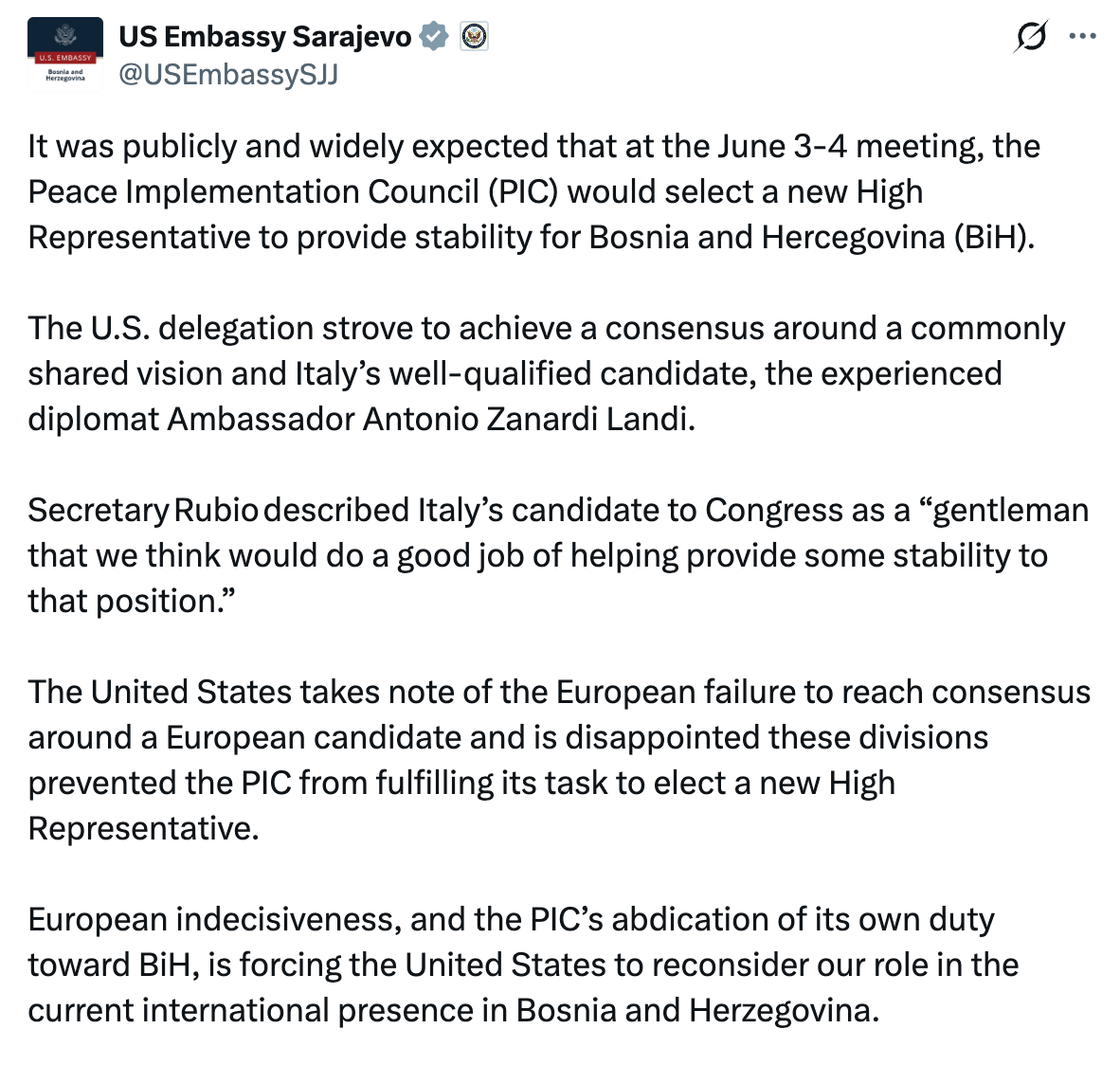
CANDIDATES. Everything is going on behind closed doors, and information circulating in the media is all from unnamed sources.
One thing is certain: the US supports Italian diplomat Antonio Zanardi Landi, the candidate Italy officially named.
Another name that has been thrown around is Rene Troccaz, allegedly supported by France, Germany, and the UK.
DIVIDE. The divide between the US and EU approach to the Balkans has grown in recent months and was on full display at the PIC. It’s a serious warning for BiH, argues political analyst Adnan Čerimagić.
SILENCE. European and international media have shown very little interest in the nomination.
Even Politico, which this morning covered the summit in Tivat in their Brussels Playbook newsletter, made no mention of the ongoing negotiations.

IN OTHER NEWS.
Kosovo will hold its third parliamentary election in less than two years on Sunday. The country has been in a prolonged political crisis, and experts doubt this vote will fix much.
Bulgaria is passing a new anti-corruption law, which is expected to help unlock around €370 million in EU funds.
In Romania, President has appointed Eugen Tomac as the new prime minister after the government fell a few weeks ago. He will now try to form a technocratic government.
A Serbian peacekeeper serving with UNIFIL died following mortar fire near Marjayoun in southeastern Lebanon. Besides Serbia, North Macedonia, Greece, and Turkey are the countries from the region currently serving in UNIFIL.

TROUBLED HERITAGE #1. BIRN published an interesting feature on the history and challenges of Sveti Stefan, one of Montenegro’s most iconic tourist landmarks and a former Yugoslav-era symbol.
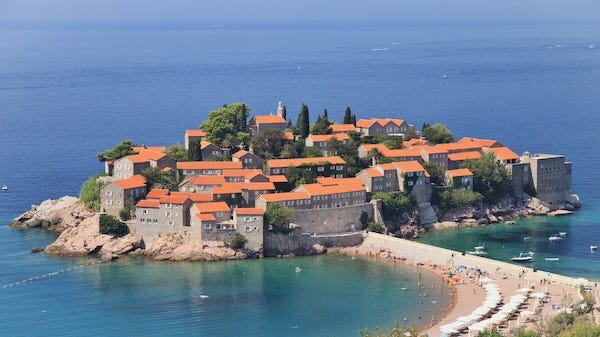
Sveti Stefan is a small island village turned luxury resort. Public access has long been restricted, making it a striking example of the country’s complex privatisation story.
TROUBLED HERITAGE #2. Despite its status as a national monument, the National Theater of Slovenia in Ljubljana is still in poor shape.
Reconstruction began over a decade ago and remains unfinished, forcing actors and artists to work elsewhere.
That’s it for this week. Got comments, suggestions, or just want to say hi? Hit reply - we’d love to hear from you.
Curious about what we do? We’ve written about it here. AI helped polish this text.
Until next week, take care,
BB
Don’t give up the day job, officers. Oh.
Albania has been the quiet playground for every grifter with a hotel plan since 1992. Trump just showed up late to the party.